


Cognitive Behavioural Therapy (CBT) in London
Private CBT Therapy at Regal Private Therapy Practice, Harley Street Medical District







What is Cognitive Behavioural Therapy?
Cognitive Behavioural Therapy (CBT) is the most extensively researched psychological therapy in the world, and the treatment recommended by the National Institute for Health and Care Excellence (NICE) as a first-line intervention for anxiety, depression, OCD, and PTSD.
Many clients come to Regal Private Therapy Practice, having previously tried therapy that didn't work, often because it didn't target the specific factors maintaining their distress. For example, someone seeing a counsellor or psychodynamic therapist for anxiety may find the experience supportive, but without addressing those maintaining factors, CBT argues that distress can persist or worsen over time.
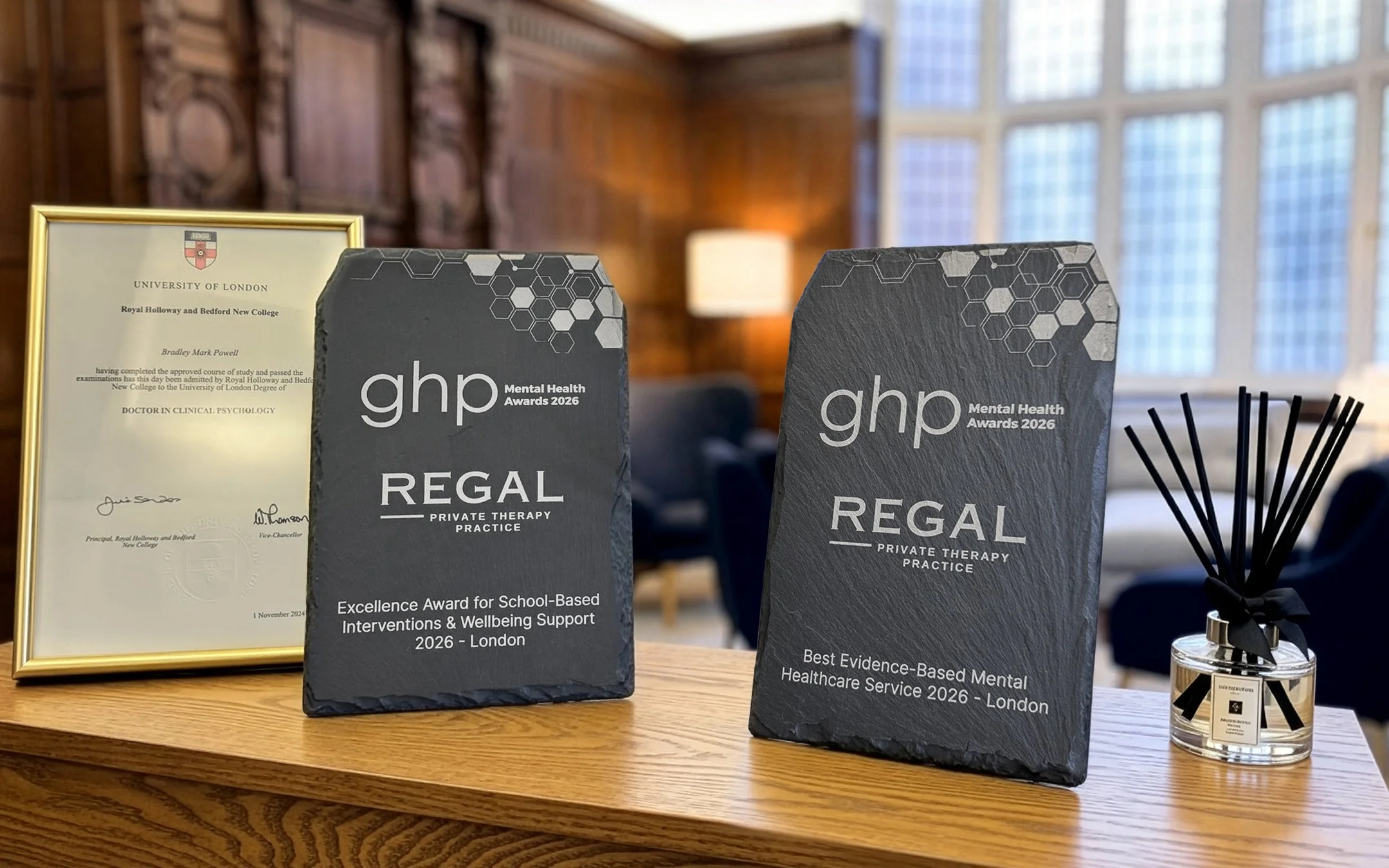
We offer private CBT in London's Harley Street Medical District, delivered by two HCPC-registered, BABCP-accredited Clinical Psychologists with doctoral-level training. Awarded ‘Best Evidence-Based Mental Healthcare Service 2026’ in London, our approach is rigorous, personalised, and grounded in the highest standards of clinical practice.
CBT: The Gold-Standard
CBT is built on a well-established principle: our thoughts, feelings, physical sensations, and behaviours are interconnected. When patterns of thinking become unhelpful or distorted, they reinforce anxiety, low mood, and avoidance, creating cycles that become difficult to break without structured support.
CBT helps you to identify and understand these patterns, then change them, not simply by thinking positively, but by developing a more accurate, flexible, and evidence-based relationship with your own mind.
The approach was developed in the 1960s by psychiatrist Aaron T. Beck, initially for depression, and has since been validated across dozens of conditions in thousands of clinical trials. CBT is considered the gold-standard evidence-based intervention for treating anxiety and related disorders, and is recommended by NICE as a first-line treatment for depression, either alone or in combination with other approaches.
Through CBT at Regal, you will learn to:
Identify and challenge unhelpful thinking patterns
Reduce behaviours that sustain distress
Build practical, evidence-based strategies for managing emotions
Develop long-term psychological resilience that extends beyond the therapy room
What CBT Can Help With
CBT is effective across a wide range of presentations. The conditions listed below are supported by NICE guidance and peer-reviewed clinical evidence.
-
Persistent worry, panic attacks, and a constant sense of being on edge are among the most common reasons people seek CBT. Structured CBT reduces anxiety symptoms and helps rebuild confidence and a sense of control.
-
CBT addresses the patterns of negative thinking and behavioural withdrawal that sustain depression. CBT is one of the most extensively studied psychological therapies for depression, with evidence supporting its use across mild, moderate, and severe presentations.
-
We offer specialist CBT approaches for OCD, including Exposure and Response Prevention (ERP), which is recommended by NICE as the primary psychological treatment for obsessive compulsive disorder.
-
Trauma-focused CBT helps individuals process traumatic experiences and reduce their ongoing impact. NICE recommends trauma-focused CBT as a first-line treatment for PTSD.
-
CBT supports the development of genuine confidence in social situations, rather than avoidance strategies that provide short-term relief but reinforce anxiety over time.
-
CBT breaks the cycle of reassurance-seeking and symptom monitoring that sustains health anxiety, helping individuals develop a more proportionate relationship with physical sensations.
-
CBT-Enhanced (CBT-E), developed specifically for eating disorders, is a leading evidence-based treatment for anorexia and bulimia nervosa, and is recommended in NICE guidance.
-
Many individuals who appear to be coping externally are managing significant internal pressure. CBT provides a structured space to recalibrate, understand the drivers of burnout, and develop more sustainable ways of functioning.
How CBT Works at Regal
A Thorough Assessment
Every course of CBT at Regal begins with a detailed clinical assessment. Rather than moving straight into techniques, we first develop a personalised formulation: a clear, shared understanding of what is maintaining your difficulties and how best to address them. This is the foundation of effective therapy.
Structured, Goal-Oriented Sessions
CBT is typically delivered over a defined course of sessions, most commonly between eight and twenty, depending on the complexity and nature of the presenting difficulty. Sessions are structured and purposeful, each designed to move you forward in a concrete way.
Active Work Between Sessions
CBT is not something that happens only in the therapy room. You will be supported to apply strategies between sessions, translating insight into real-world change. This is one of the defining features of CBT, and a key reason for its strong outcomes in clinical research.
Measurable Progress
We use validated outcome measures throughout therapy to track progress objectively. This is consistent with the evidence-based ethos of CBT and ensures that the work is actually achieving what it should.
CBT vs Other Therapies: Key Differences
People considering private therapy in London often ask how CBT compares to other approaches. The honest answer is that no single therapy suits everyone, and the most important factor is clinical fit. That said, some distinctions are worth understanding.
CBT differs from psychodynamic or psychoanalytic therapy in its focus on present-day patterns rather than historical exploration. It differs from counselling in its structure, specificity, and the volume of evidence behind it. It differs from ACT (Acceptance and Commitment Therapy) in that CBT typically focuses on modifying the content of unhelpful thoughts. In contrast, ACT focuses on changing your relationship to thoughts without necessarily challenging their content. Both are evidence-based; which is more appropriate depends on your presentation and goals.
At Regal, we offer both CBT and ACT, and where appropriate our clinicians will integrate approaches or recommend the most suitable path at assessment.
Why Choose Regal for Private CBT in London?
❋ Clinical Psychologist-led therapy, not just CBT therapistsBoth Dr Bradley Powell and Dr Ashleigh Powell hold doctoral-level qualifications in Clinical Psychology (DClinPsy), are registered with the HCPC, and are BABCP-accredited Cognitive Behavioural Therapists. This is a higher standard of qualification than many private CBT providers in London, where the term "CBT therapist" covers a wide range of training levels.
❋ Located in Harley Street's Medical DistrictOur clinic at 4 Devonshire Street, Marylebone, sits within London's internationally recognised centre for specialist medical and psychological care.
❋ Integrated care where neededWhere appropriate, we can coordinate care with psychiatrists and other specialists, ensuring a cohesive approach for more complex presentations.
❋ Outcome monitoring as standardWe track progress using validated clinical measures throughout treatment, so you are never relying on subjective impression alone.
Our CBT Clinicians

DClinPsy | BABCP-Accredited CBT Therapist | HCPC Registered | BPS Member
Dr. Ashleigh Powell
-
Dr Ashleigh Powell is Co-Founder and Co-CEO of Regal Private Therapy Practice. She completed her doctoral and postgraduate clinical training at Royal Holloway, University of London, and King's College London. A specialist in CBT, ACT, and Compassion Focused Therapy (CFT), she works with adults, adolescents, and children across anxiety disorders, OCD, depression, low self-esteem, trauma, and burnout.

DClinPsy, PGDip CBT, MSc Developmental Psychology, BSc Psychology | HCPC Registered | BABCP Accredited | BPS Chartered | Associate Fellow of the BPS
Dr. Bradley Powell
-
Dr Bradley Powell is Co-Founder and Co-CEO of Regal Private Therapy Practice, and an award-winning Clinical Psychologist based in Harley Street. He provides CBT and integrative therapy for anxiety, OCD, trauma, panic, and low self-esteem, alongside specialist ADHD and autism assessments. His academic research has been published in peer-reviewed journals, and he has served as a peer-reviewer for parliamentary briefings.
Frequently Asked Questions
How many CBT sessions will I need?
This varies by individual and presentation. NICE-recommended courses typically range from six to twenty sessions. More complex presentations may benefit from a longer or phased course of therapy. Your clinician will give you a clear indication at assessment.
Is private CBT in London worth it compared to NHS therapy?
NHS CBT is typically delivered by psychological wellbeing practitioners or therapists with diploma-level training, usually in a brief, structured format. At Regal Private Therapy Practice, CBT is delivered by doctoral-level Clinical Psychologists with BABCP accreditation, enabling a more comprehensive formulation, greater clinical flexibility, and faster access than national waiting times typically permit.
Can CBT be done online?
Yes. We offer secure video sessions alongside in-person appointments. Research consistently supports the effectiveness of online CBT, and for many clients it offers a practical and equally effective alternative to attending in person.
Is CBT effective for children and young people?
Our clinicians work with adults, adolescents, and children. CBT is well evidenced for a range of difficulties in younger people, including anxiety, OCD, and depression, and is adapted appropriately for each age group.
How is CBT different from talking therapy or counselling?
CBT is a structured, evidence-based treatment with a specific model and defined techniques. Counselling and general talking therapies tend to be less structured and less directive. CBT is particularly suited to those who want a clear framework, measurable progress, and practical tools to use beyond the therapy room.
What is the difference between CBT and CBT-E?
CBT-E (Enhanced Cognitive Behavioural Therapy) is a specialist adaptation of CBT designed specifically for eating disorders. It was developed by Professor Christopher Fairburn at Oxford and is recommended in NICE guidance for anorexia and bulimia nervosa.
Do I need a referral to access private CBT at Regal?
No referral is needed. You can contact us directly to arrange an initial consultation.
A Discreet Harley Street Setting
Therapy at Regal Private Therapy Practice is delivered within a confidential, carefully considered clinical environment at 4 Devonshire Street, Marylebone, London W1W 5DT, within the Harley Street Medical District.
We offer:
One-to-one sessions with HCPC-registered, BABCP-accredited Clinical Psychologists
In-person appointments in Marylebone
Secure online sessions
Flexible scheduling, including some evening availability
